
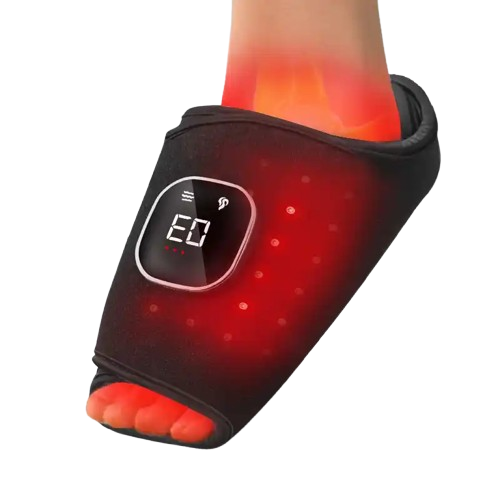
A smart red light therapy ankle wrap is a wearable device embedded with dual-wavelength LEDs (660nm red and 850nm near-infrared) that delivers photobiomodulation (PBM) directly to the ankle joint. Designed for hands-free, at-home recovery, these smart wraps treat ankle sprains, arthritis, tendonitis, and post-surgery stiffness by boosting cellular ATP production, reducing inflammation, and accelerating tissue repair — making them ideal for athletes, active adults, and anyone managing chronic ankle pain.
Unlike stationary panels that lose light intensity over distance, a smart ankle wrap conforms to the ankle’s complex anatomy and delivers light with zero distance loss through direct skin contact. Smart features such as programmable pulse modes (10Hz–40Hz), built-in auto-timers, and app-controlled intensity settings allow users to customize treatment precisely. With consistent use of 15–20 minutes per session, 3–7 times per week, users typically report meaningful pain reduction within the first week and significant mobility improvements within 2–4 weeks.
Table of Contents

1. What Is a Smart Red Light Therapy Ankle Wrap?
A smart red light therapy ankle wrap is a wearable photobiomodulation device purpose-built for the ankle joint. It consists of a flexible fabric strap embedded with multiple LED diodes that emit specific therapeutic wavelengths — typically 660nm red light for surface tissue and 850nm near-infrared light for deep joint and tendon penetration. The wrap is contoured to fit the ankle’s natural shape and secured with adjustable Velcro straps for consistent LED-to-skin contact.
The technology is rooted in photobiomodulation (PBM), a non-thermal therapeutic approach first studied by NASA in the 1980s. What makes a smart ankle wrap different from basic models is the integration of programmable controls: adjustable pulse frequencies (10Hz for nerve modulation, 40Hz for cellular repair), multiple treatment modes (Red-only, NIR-only, or combined), auto-shutoff timers, and in some advanced models, Bluetooth app connectivity for session tracking and dosage optimization.
Key components of a typical smart red light therapy ankle wrap include:
- Dual-wavelength LED array: 40–270 LED chips emitting 660nm red + 850nm NIR light
- Smart control unit: Microprocessor-controlled with pulse mode selection, intensity levels, and auto-timer
- Anatomically contoured wrap: Curved neoprene or breathable fabric shaped to fit the ankle mortise
- Fastening system: Adjustable Velcro straps for secure, hands-free wear around the ankle and foot
- Power source: USB-C rechargeable battery (1800–5000 mAh) or direct USB power for extended sessions

| Feature | Typical Range | Purpose |
|---|---|---|
| Red wavelength | 630–660 nm | Skin healing, circulation, superficial tissue repair |
| NIR wavelength | 810–880 nm | Deep joint, tendon, ligament penetration; inflammation reduction |
| LED count | 40–270 chips | Determines coverage area and light uniformity around ankle |
| Pulse modes | 10Hz / 40Hz / Continuous | 10Hz for nerve pain; 40Hz for cellular repair |
| Session duration | 10–20 minutes | Optimal therapeutic window with auto shut-off |
| Battery life | 3–6 sessions per charge | Enables daily use without cord dependency |
2. How Does a Smart Red Light Therapy Ankle Wrap Work?
A smart red light therapy ankle wrap works by delivering photons from red and near-infrared LEDs through the skin directly into the ankle’s soft tissues. These photons are absorbed by cytochrome c oxidase in the mitochondria, triggering a well-documented cascade known as photobiomodulation. This process increases ATP production by 15–30%, reduces oxidative stress, and stimulates nitric oxide release for improved microvascular perfusion around the injured ligaments and tendons.
The dual-wavelength design targets two distinct tissue depths critical for ankle recovery:
- 660nm red light penetrates approximately 1–3 mm, reaching the epidermis and superficial ligaments. It stimulates fibroblast proliferation, collagen synthesis, and surface-level circulation — essential for reducing visible swelling and supporting skin healing around the ankle.
- 850nm near-infrared light penetrates 3–8 mm, reaching the deep ankle ligaments (anterior talofibular ligament, calcaneofibular ligament), joint capsule, and synovium. It modulates inflammatory cytokines, accelerates tendon collagen remodeling, and provides deep pain modulation.
Clinical evidence strongly supports this mechanism. A landmark 2024 systematic review and meta-analysis published in Lasers in Medical Science examining 598 patients across 6 studies concluded that photobiomodulation therapy showed a high effect size with moderate evidence for pain intensity reduction in ankle sprain recovery. An earlier randomized controlled trial of 40 patients found that 627nm LED therapy significantly reduced edema at 24, 48, and 72 hours compared to placebo when applied alongside the standard PRICE protocol. Read the full meta-analysis on PubMed.
The wrap’s direct-contact design is particularly important for ankle therapy. Because the ankle has a complex curved surface with many bony prominences, rigid panels cannot maintain consistent contact. A contoured wrap ensures the LEDs remain at zero distance from the skin over the medial and lateral malleolus — the primary sites of ligament injury in most ankle sprains.

3. What Are The Key Benefits?
3.1 Accelerated Sprain Recovery
A smart red light therapy ankle wrap significantly speeds recovery from Grade I and II ankle sprains. The 2024 meta-analysis confirmed high effect sizes for pain reduction. In a clinical trial with university athletes, return-to-play time dropped from 19 days to just 9.6 days when RLT was added to standard care — a reduction of nearly 50%. See the clinical trial details on ClinicalTrials.gov.
3.2 Non-Invasive Pain Relief
Photobiomodulation modulates pain through multiple pathways — reducing local prostaglandin load, inhibiting substance P release, and promoting endorphin-mediated pain suppression. A comparative study found that laser therapy reduced NPRS pain scores from 3.22 to 1.05 over 4 weeks, outperforming kinesio taping. For those seeking drug-free ankle pain management, RLT offers a clinically validated alternative.
3.3 Reduced Swelling and Edema
Excessive edema delays ligament remodeling and prolongs immobility. A randomized placebo-controlled trial demonstrated that LED phototherapy at 627nm significantly reduced ankle swelling compared to placebo, with measurable differences appearing within 24 hours of the first session. The wrap’s direct-contact design maximizes this anti-edema effect.
3.4 Improved Joint Mobility and Flexibility
Chronic ankle stiffness limits daily function and increases re-injury risk. By reducing inflammation in the joint capsule and promoting synovial fluid health, regular use of a smart ankle wrap improves dorsiflexion range of motion — a key biomechanical parameter linked to lower injury risk in athletes and active adults.
3.5 Smart Customization for Optimal Dosing
What sets smart wraps apart is programmable pulse technology. Research shows that 10Hz pulsing is optimal for nerve pain modulation, while 40Hz better stimulates mitochondrial repair. Smart wraps allow users to select the right frequency for their specific condition — acute vs. chronic, ligament vs. nerve involvement — ensuring treatment is both precise and effective.
| Benefit | Timeframe for results | Clinical support level |
|---|---|---|
| Pain relief | 3–5 sessions | Strong (meta-analysis, 598 patients) |
| Swelling reduction | 24–72 hours | Strong (RCT, 40 patients) |
| Return-to-play | 9.6 vs 19 days | Moderate (athlete trial) |
| Joint mobility | 2–4 weeks | Moderate (clinical studies) |
| Chronic arthritis relief | 8–12 weeks | Moderate (case series) |
4. Key Factors To Consider
4.1 Wavelength Configuration
Ensure the wrap offers both 660nm red and 850nm near-infrared wavelengths. Single-wavelength devices cannot penetrate both superficial and deep ankle tissues. The 850nm NIR is particularly critical for reaching the deep ligaments (ATFL, CFL) and joint capsule.
4.2 Pulse Mode Availability
Smart wraps with selectable pulse frequencies (10Hz, 40Hz, Continuous) provide more precise treatment. Research confirms that different pulse rates produce different biological effects — slower pulses for nerve pain, faster for cellular repair.
4.3 Anatomical Fit and Coverage
The ankle has unique curvature. A good wrap must contour around the medial and lateral malleoli without gaps. Look for shaped wraps (not generic flat pads) with adjustable straps that secure the LEDs over the anterior talofibular ligament — the most commonly injured ankle structure.
4.4 Power Density and LED Density
Irradiance should be at least 25 mW/cm² at the skin surface. Higher LED counts (100+) provide more uniform coverage across the ankle’s irregular surface. Wraps with 3-chip LEDs (1 red + 2 NIR per node) offer superior depth penetration.
4.5 Smart Features and Ease of Use
Auto shut-off (20-minute timer), USB-C rechargeability, and multiple treatment modes distinguish smart wraps from basic models. App connectivity for session tracking is a premium feature but not essential for clinical results — consistency matters more than connectivity.

Ready to find the perfect smart red light therapy ankle wrap?
Compare top-rated devices with dual-wavelength LEDs, smart pulse modes, and real user reviews.
5. Technical Specifications Checklist
| Specification | Entry-Level | Mid-Range | Premium |
|---|---|---|---|
| Red wavelength | 630 nm | 660 nm | 660 nm |
| NIR wavelength | 850 nm | 850 nm | 810nm + 850nm |
| LED count | 40–60 | 80–120 | 200–270 |
| Power density | 15–25 mW/cm² | 25–50 mW/cm² | 50–120 mW/cm² |
| Pulse modes | None | 10Hz fixed | 10Hz / 40Hz / Continuous |
| Battery | USB corded | 1800–3000 mAh | 4000–5000 mAh |
| Auto timer | Yes (fixed 20min) | Adjustable 10–30min | App-customizable |
| FDA clearance | No | Yes | Yes |
| App connectivity | No | No | Yes |
| Warranty | 1 year | 1–2 years | 2–5 years |
| Essential parameter | Recommended value | Why it matters |
|---|---|---|
| Minimum irradiance | 25 mW/cm² | Below this, ankle penetration is insufficient for deep ligaments |
| Dual wavelength | 660nm + 850nm | 850nm NIR is essential for ATFL and joint capsule penetration |
| Anatomical shape | Contoured for ankle | Flat pads leave gaps over medial/lateral malleolus |
| Auto shut-off | Yes (10–20 min) | Prevents overexposure on sensitive ankle skin |
| Pulse capability | 10Hz / 40Hz | 10Hz for acute nerve pain; 40Hz for chronic repair |

6. Common Mistakes To Avoid
6.1 Using on an Unconfirmed Fracture
If you heard a crack at the time of injury, cannot bear weight, or have point tenderness over the fibula or fifth metatarsal, seek medical assessment first. RLT should only be used once a fracture has been ruled out and skin is intact.
6.2 Starting Too Early After Acute Injury
Wait 24–48 hours after an acute ankle sprain before starting RLT. The initial inflammatory phase plays a critical role in tissue repair signaling, and applying PBM too early may theoretically interfere with this process. After 48 hours, daily use is clinically supported.
6.3 Using Over Clothing or Bandages
Red and NIR light cannot penetrate fabric, compression bandages, or athletic tape effectively. Always apply the wrap directly against clean, bare skin. If an ACE bandage is required for stability, remove it during the 15–20 minute RLT session and reapply afterward.
6.4 Treating Only One Side of the Ankle
Many users place the wrap only over the lateral ankle (where ATFL injuries occur), but the medial side also benefits from light therapy. Look for wraps with sufficient LED coverage to treat both malleoli simultaneously for balanced recovery.
6.5 Expecting RLT to Replace Rehabilitation
Red light therapy accelerates healing but does not rebuild proprioception, strength, or balance. Combine daily RLT sessions with progressive loading, range-of-motion exercises, and physiotherapy-guided rehabilitation for optimal outcomes.
7. Comparison: Smart Ankle Wrap vs. Full-Body LED Panel
| Factor | Smart Ankle Wrap | Full-Body LED Panel |
|---|---|---|
| Portability | Excellent — wearable, cordless, fits in a bag | Limited — stationary, requires power outlet |
| Ankle-specific design | Yes — contoured to ankle anatomy | No — flat surface cannot conform to ankle |
| Skin contact | Direct (zero light loss) | Distance-based (light scatters before reaching ankle) |
| Smart features | Pulse modes, auto-timer, app control | Typically basic on/off |
| Hands-free use | Yes — walk or work during treatment | No — must sit with ankle positioned toward panel |
| Power at target | 25–120 mW/cm² (consistent) | 10–30 mW/cm² (varies by distance) |
| Cost | $80–$400 | $300–$2,000+ |
| Best for | Targeted ankle sprain, tendonitis, arthritis | Full-body wellness, systemic inflammation |
Which should you choose? If your primary concern is ankle-specific — a recent sprain, chronic ankle instability, Achilles tendonitis, or post-surgical recovery — a smart ankle wrap delivers superior targeted therapy at a fraction of the cost. If you also want whole-body benefits, many users pair a wrap for daily ankle care with a panel for general wellness.
8. Frequently Asked Questions
9. Conclusion
A smart red light therapy ankle wrap offers a clinically validated, non-invasive, and highly convenient solution for ankle sprain recovery, chronic pain management, and post-surgery rehabilitation. By delivering dual-wavelength 660nm red and 850nm near-infrared light directly to the ankle joint with smart programmable controls, these devices bring professional-grade photobiomodulation into daily home use.
When selecting a smart ankle wrap, prioritize dual-wavelength capability (660nm + 850nm), anatomical contouring for the ankle, adequate power density (25+ mW/cm²), and pulse mode selection for treatment customization. Consistency is the single most important factor: 15–20 minutes daily, 5–7 times per week during acute recovery, with direct skin contact. For further reading, the 2024 meta-analysis in Lasers in Medical Science provides the most comprehensive evidence review.
Experience the difference that targeted, smart photobiomodulation can make in your ankle recovery journey.
