
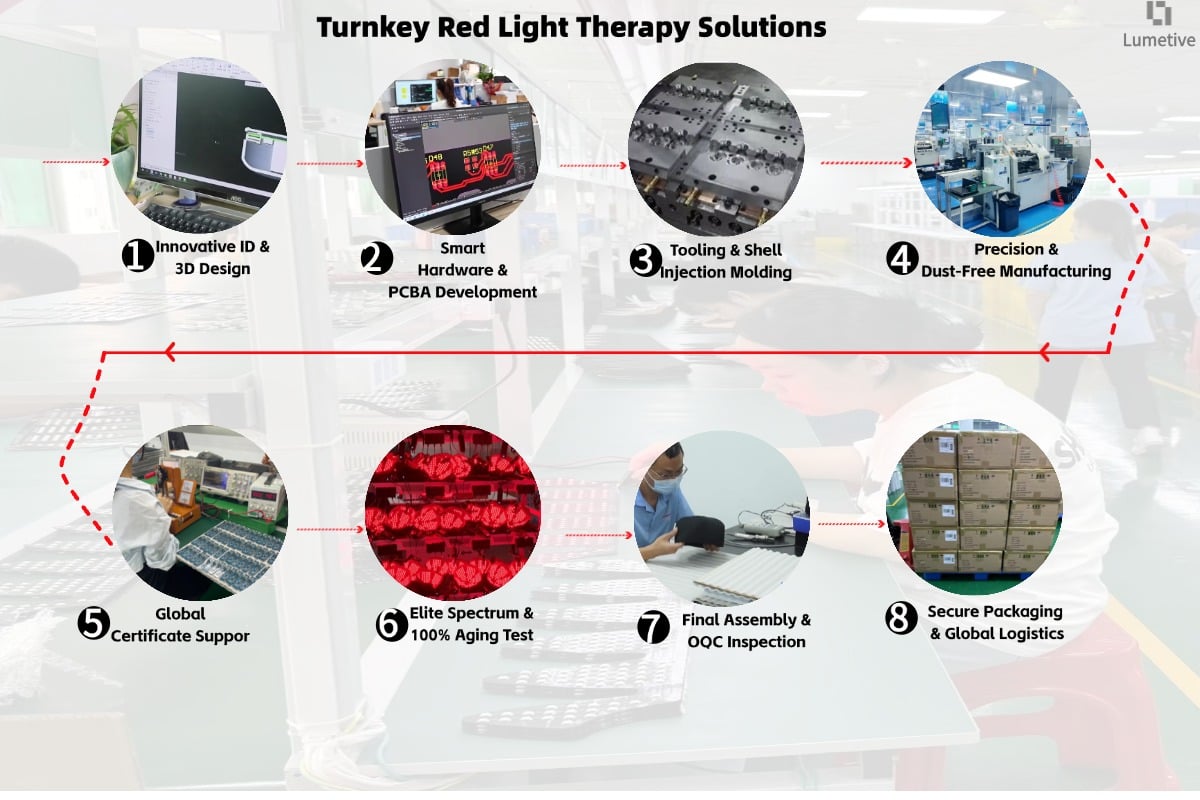
Overview
Choosing a red light therapy device OEM manufacturer requires evaluating wavelength accuracy, irradiance consistency, ISO 13485 quality systems, regulatory compliance, engineering capability, thermal management, customization, and production capacity. This guide explains how to identify a reliable OEM manufacturing partner and reduce development risk.
Introduction to the Red Light Therapy Industry
What Is Red Light Therapy?
Red light therapy (RLT), also known as photobiomodulation (PBM), uses specific wavelengths of 660nm red light and 850nm near-infrared light to stimulate mitochondrial ATP production. Over 500 peer-reviewed studies support its applications for skin health, muscle recovery, joint pain relief, and inflammation reduction.
Why Is Demand Growing?
Growing scientific research, home wellness adoption, sports recovery trends, skincare demand, and preference for non-invasive treatments drive market expansion. The global red light therapy market surpassed billion in 2025 and is projected to grow steadily through 2032.
Why Brands Choose an OEM Manufacturer
OEM vs ODM
OEM develops products to your exact specifications. ODM provides pre-designed products with branding. OEM is ideal for brands with specific technical requirements, while ODM suits faster market entry.
Benefits of OEM Manufacturing
- Custom engineering tailored to your target market
- Brand differentiation through unique product design
- Lower investment compared to building your own factory
- Scalable production from pilot to mass production
Red Light Therapy Market Growth
| Segment | Growth | Key Driver |
|---|---|---|
| Home Use | High | Consumer wellness adoption |
| Beauty and Skincare | High | Anti-aging demand |
| Sports Recovery | High | Athlete adoption |
| Clinical and Medical | Steady | FDA-cleared devices |
How to Evaluate an OEM Manufacturer
LED Quality
Verify LED sourcing from reputable suppliers. High-quality LEDs maintain consistent output for over 30,000 hours. Ask which LED brands they use and request datasheets.
Wavelength Accuracy
Request spectrometer reports confirming optical output. Clinically validated wavelengths include 630nm, 660nm, 810nm, and 850nm. Tolerance should be within +-5nm.
Irradiance Testing
Review irradiance maps and testing methodology. Effective devices deliver at least 50-100 mW/cm2 at treatment distance. Request third-party testing reports.
Thermal Management
Aluminum housings and active cooling improve LED lifespan and maintain consistent irradiance throughout treatment sessions of 10-20 minutes.
Customization
Evaluate the manufacturer ability to customize industrial design, firmware, branding, and packaging. Look for manufacturers with strong R&D teams that support wavelength configuration and app integration.
Quality Standards
ISO 13485
ISO 13485 certification ensures the manufacturer follows medical-device quality management systems including documented procedures, audits, and corrective action processes.
Incoming Inspection
Critical components including LEDs, drivers, and PCBs should be inspected before assembly. A reliable manufacturer tests all incoming components.
Final Inspection
Every batch should undergo electrical safety testing, optical output verification, and functional testing. Burn-in tests identify early failures before shipment.
Regulatory Compliance
FDA (United States)
FDA 510(k) clearance is required for therapeutic devices sold in the US. Your OEM manufacturer should have existing FDA clearances for similar products.
CE (European Union)
CE marking under the Medical Device Regulation (MDR) is mandatory for EU entry. Ensure your manufacturer has MDR experience.
RoHS and FCC
RoHS compliance covers environmental safety. FCC certification covers electromagnetic compatibility. Both are typically required for North America and EU.
OEM Manufacturing Process
1. Specification
Define technical requirements including wavelengths, power output, size, features, and certifications. Your manufacturer provides a detailed spec document.
2. Prototype
The manufacturer creates initial samples. Expect 2-4 weeks for prototype development. Test thoroughly before mass production approval.
3. Validation
Conduct EMC testing, safety certification, and performance validation. Your manufacturer provides test reports from accredited labs.
4. Pilot Production
A small batch of 50-200 units validates production readiness and quality control processes before scaling.
5. Mass Production
Full-scale production with ongoing quality monitoring and regular inspection reports throughout production.
Common Challenges
Quality Consistency
Ensure your manufacturer has documented QC procedures and batch-to-batch consistency testing. Request samples from different production runs.
Supply Chain
Component shortages can delay production. Choose manufacturers with established supplier relationships and multiple sourcing options.
Communication
Work with manufacturers that have English-speaking account managers and responsive communication channels to avoid misunderstandings.
Intellectual Property
Protect your designs with NDAs and clear IP ownership agreements. Reputable manufacturers respect IP boundaries.
Frequently Asked Questions
What wavelength is best for red light therapy?
660nm red light and 850nm near-infrared light are the most clinically validated combination. 660nm targets surface tissue, while 850nm penetrates deeper for muscle and joint treatment.
What certifications are important for an OEM manufacturer?
ISO 13485, FDA 510(k), CE marking under MDR, RoHS, and FCC are commonly required depending on your target markets.
How can I evaluate red light therapy device quality?
Check irradiance levels, wavelength accuracy, thermal management, LED brand sourcing, and QC records. Always request physical samples before production.
Should I choose OEM or ODM?
OEM offers full customization for established brands with specific requirements. ODM is faster to market with lower investment, ideal for startups.
How long does OEM product development take?
Typically 3-6 months. Prototype development takes 2-4 weeks, validation 4-8 weeks, and mass production setup 2-4 weeks.
Conclusion
An experienced OEM partner with strong engineering, quality systems, and regulatory expertise helps launch reliable red light therapy devices. The right OEM manufacturing partner provides the technical foundation your brand needs.