
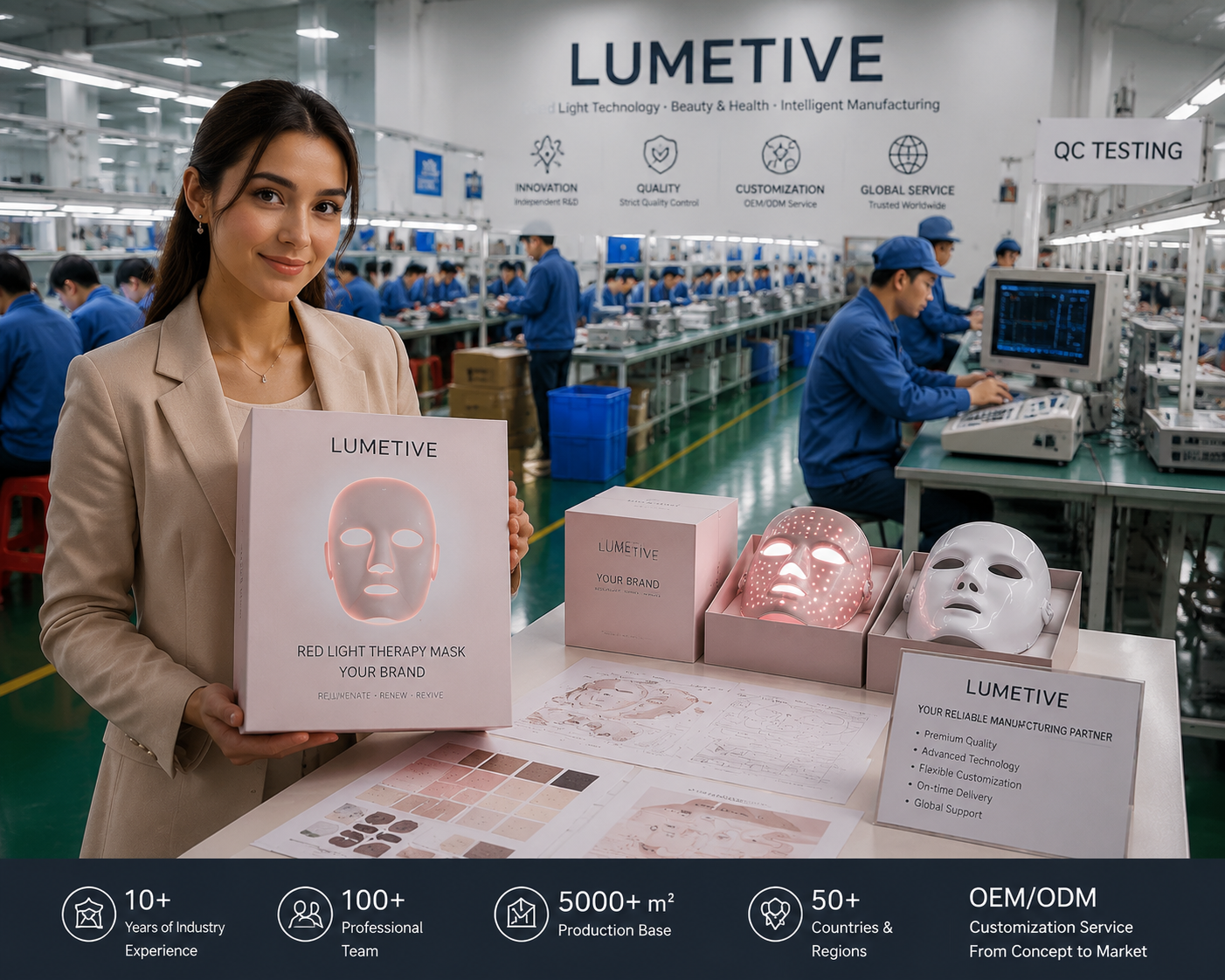
The red light therapy market is growing fast. In 2025, the global market for red light therapy devices surpassed 10 billion dollars, and projections show steady growth through 2032. This rapid expansion has attracted entrepreneurs, wellness brands, beauty clinics, and e-commerce sellers who want to enter the space with their own product lines.
But building a red light therapy device from scratch requires deep technical knowledge, expensive equipment, and years of R&D. Most brands do not have these resources. That is why partnering with a red light therapy ODM factory has become the most practical path to market.
Why Brands Choose ODM Over OEM
Before choosing a factory, it helps to understand the difference between ODM and OEM. OEM (Original Equipment Manufacturer) requires the brand to provide the product design and the factory builds it. The brand controls every technical detail, from wavelength selection to housing shape. OEM requires a strong internal product development team and a larger budget.
ODM (Original Design Manufacturer) works differently. The factory already has ready-made products. The brand selects a design, requests changes such as custom colors, logo printing, or packaging adjustments, and the factory handles the rest. ODM is faster, cheaper, and requires less technical input from the brand. For first-time entrepreneurs and growing wellness brands, ODM is often the better choice.
ODM vs OEM: Key Differences
| Factor | ODM | OEM |
|---|---|---|
| Product Design | Factory provides existing designs | Brand provides custom designs |
| Time to Market | Weeks to months | Months to years |
| Initial Investment | Low to medium | High |
| Technical Expertise | Minimal required | Extensive needed |
| Customization Control | Limited to factory portfolio | Full control over specs |
| Best For | New brands, startups | Established healthcare brands |
The red light therapy industry has matured significantly. Most common device types, including panels, face masks, handheld wands, and belts, have standardized technical foundations. This maturity is exactly why ODM has become so widespread. Brands no longer need to reinvent the wheel.
Evaluating Factory Credentials
The first step in choosing an ODM factory is verifying its credentials. Many factories claim to be experienced manufacturers, but not all have the certifications, facilities, and track record to back up those claims.
Business Registration and History
Check when the company was officially registered. A factory operating for five years or more in the red light therapy space usually has stable supply chains and proven production processes. A company operating for ten years or more often has stronger engineering capabilities. Look for consistent growth in factory size, production lines, and workforce over time.
Certifications
Certifications are among the most important factors in choosing an ODM partner. For the US market, FDA 510(k) clearance is essential. For Europe, look for CE marking under the Medical Device Regulation. For Canada, MDSAP certification is required. Australia requires TGA registration.
A factory that holds multiple certifications demonstrates a commitment to quality and compliance. When you partner with such a factory, you inherit their certification foundation, dramatically reducing your own compliance burden.
Factory Size and Production Capacity
A factory\’s physical size and production capacity tell you a lot about its ability to fulfill orders consistently. Larger factories typically have multiple production lines, handle higher order volumes, and manage peak season demand more effectively. Look for factories with several thousand square meters of production space and monthly capacity of tens of thousands of units.
Research and Development Team
The quality of a factory\’s R&D team directly affects product quality and customization depth. A strong R&D team can optimize wavelength configurations, improve irradiance levels, and integrate advanced features such as app control or pulse modes. Factories that invest in patents develop their own technology rather than copying competitors\’ designs.
Evaluating Product Quality
Request Samples
Always order samples before committing to a partnership. Test the device yourself for consistent irradiance, even LED heating, and build quality. Use a spectrometer to verify wavelengths and a power meter to measure irradiance. High-quality LEDs from reputable manufacturers maintain consistent output over thousands of hours.
Assess Quality Control Processes
A reliable ODM factory conducts testing at multiple production stages: incoming component inspection, in-process assembly checks, and finished device power-on testing. Some factories perform burn-in tests running devices for hours or days to identify early failures. ISO 13485 certification ensures rigorous quality management systems.
Customization Capabilities
Basic customizations include logo printing, custom packaging, and user manual design. Advanced options include wavelength configuration (630nm, 660nm, 810nm, 850nm), custom housing colors, form factor modifications, and app control integration. Ask about MOQ for each customization level – basic logo changes start at 10-50 units, while full custom development may require 500-1000 units.
Minimum Order Quantities and Pricing
MOQ affects your initial investment and risk. Some factories offer very low MOQs for stock products – 10 to 50 units with your logo applied. Full ODM projects with new molds typically start at 500 to 1000 units. Do not focus only on price; balance it with quality. Ask for a detailed quote covering unit price, tooling, packaging, and shipping costs.
Communication and Support
The quality of communication is often overlooked but critically important. Evaluate a factory\’s responsiveness during initial discussions. Do they answer within 24 hours? Do they provide specific technical answers? Many reputable ODM factories have international sales teams fluent in English. Look for factories that assign a dedicated account manager to your project.
Shipping and Logistics
Ask about lead times – typically 1-3 days for stock products and 20-40 days for customized orders. Chinese factories experience capacity constraints around Chinese New Year. Ask about shipping methods, warehousing services, and warranty policies. Reputable factories offer 1 to 5 year warranties covering LED failure and manufacturing defects.
Common Mistakes to Avoid
First, focusing only on price. A factory offering the lowest price often cuts corners on LED quality and materials. The resulting product has inconsistent performance and shorter lifespan. Second, skipping the sample phase. Test the device yourself before committing to a large order. Third, underestimating certification requirements. Some certifications are tied to the manufacturer, but others require brand-specific testing. Fourth, overcommitting on the first order. Start small and scale. Fifth, failing to plan for growth. Choose a factory that can scale with your brand.
Conclusion
The red light therapy market offers a significant opportunity for brands that enter it with quality products and strong positioning. Choosing the right ODM factory is the single most important decision in that process. A good factory provides engineering expertise, certification support, quality assurance, and a foundation for your brand to grow.
Take the time to research potential partners. Verify their credentials. Test their products. Start with a small order and scale gradually. The brands that choose their ODM partners wisely will capture the most value and build the most sustainable businesses.
Frequently Asked Questions
What is the difference between ODM and OEM in red light therapy?
OEM requires the brand to provide product designs, while ODM allows brands to choose from the factory\’s existing product portfolio with custom branding. ODM is faster, more affordable, and requires less technical expertise, making it the preferred choice for new entrants to the red light therapy market.
What certifications should a red light therapy ODM factory have?
A reputable factory should hold FDA 510(k) clearance for the US, CE marking under MDR for Europe, ISO 13485 quality management certification, and market-specific certifications like MDSAP (Canada) or TGA registration (Australia). These certifications demonstrate medical-grade manufacturing compliance.
What is the minimum order quantity for red light therapy ODM?
MOQ varies by customization level. Basic logo and packaging changes start at 10 to 50 units. Full ODM projects with new molds and structural changes typically start at 500 to 1000 units or more.
How do I evaluate the quality of a red light therapy ODM product?
Always request physical samples. Test for consistent irradiance, even LED heating, and build quality. Use a spectrometer to verify wavelengths. High-quality LEDs maintain consistent output over thousands of hours, while low-quality LEDs degrade quickly.
How long does it take to produce a custom red light therapy product?
Stock products ship in 1-3 days. Customized orders take 20-40 days. Full custom development with new tooling takes 6-8 weeks. Peak seasons around Chinese New Year may extend lead times.
How do I avoid common mistakes when choosing an ODM factory?
Five key mistakes to avoid: focusing only on price, skipping the sample phase, underestimating certification requirements, overcommitting on the first order, and failing to plan for growth. Start with a small order and scale gradually with a partner that can grow with your brand.